
(Hybrid) The Message Shapes Phonology
Presenters: Kathleen Currie Hall, Andrew Wedel
Offered virtuallyHT2TFB2
A long-standing hypothesis in research on phonology is that a language's phonological system is shaped by its use in communication. Traditionally, this view has focused on trade-offs between the effort required to produce phonological units and the accuracy with which they are recognized. Based on theoretical and empirical findings, we argue that this trade-off also, or even primarily, takes into account the information that the phonological unit provides about meaning-bearing units like morphemes and words (the phonological unit's 'value' or 'utility' to the transmission of meaning). Within this workshop we integrate concepts from information theory and Bayesian inference with the existing body of phonological research. In doing so, we show that this important elaboration of existing approaches provides greater explanatory coverage of a diverse range of sound patterns. We will begin by exploring sets of phonological patterns traditionally called strong versus weak, and show how a meaning transmission-centered approach grounded in information theory and Bayesian inference can solve a range of outstanding puzzles in this domain. We end the workshop by working together extending this framework to problems beyond the strong/weak dichotomy such as vowel harmony and reduplication.
Keywords: Bayesian Inference, Communicative Efficiency, Information Theory, Probabilistic Models, Computational Modeling, Phonology, Language Change, Lexicon, Theoretical Frameworks
Room STB 245, Tuesdays and Fridays, July 25-August 8, 10:30am - 11:50am (in person and virtually)
Tuesdays and Fridays
Presenters
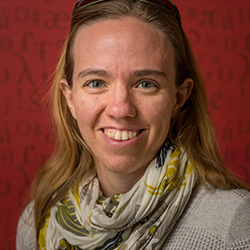
University of British Columbia
Kathleen Currie Hall's research focuses on the formational patterns of languages (phonology) using techniques from a wide variety of areas, including phonetics, psycholinguistics, sociolinguistics, and semantics. She is particularly interested in how phonological categories and processes can be objectively quantified using tools from probability, statistics, and information theory. Recently, her work has focused on the phonology of sign languages in particular, understanding how phonological patterns apply and arise in the visual modality. She has developed two open-source software tools to aid in phonological research: Phonological CorpusTools (PCT) and Sign Language Phonetic Annotator / Analyzer (SLP-AA). Dr. Hall is also especially interested in promoting good pedagogy in the linguistic classroom, helping students feel included and reach their potential as scholars.

University of Arizona
I am interested in the interaction of internal and external factors on language learning, production and processing, and how that interaction shapes trajectories of sound system change over time. As a model system, I focus on biases exerted by the lexicon on the phonological system. Specifically, I investigate how apparent utterance-level biases supporting accurate, yet cost-effective communication of lexical information influence phonetic form, and how these consistent, usage-driven shifts in phonetic form shape the long-term evolution of the sound system. To investigate linkages between usage and long-term change, I use multiple complementary methodologies, including computational simulation, statistical studies of patterns in diachronic change, corpus studies of natural language usage, and laboratory experiment.
Room STB 245, Tuesdays and Fridays, July 25-August 8, 10:30am - 11:50am (in person and virtually)
Tuesdays and Fridays