
Prosodic Development Across Languages
Presenters: Aoju Chen
T2TFD2
Prosody (i.e., the melody and rhythm of language) is vital to both the structure of speech and communication. Children exhibit a stunning sensitivity to prosody already from birth and develop remarkable prosodic competence within their first years. This early prosodic ability is foundational to development in word segmentation, vocabulary, and morpho-syntax. Traditionally, language development research has focused on non-prosodic aspects, while prosodic research has primarily centered on adult models. This workshop offers an innovative perspective, delving into how children acquire the prosodic system of their native language. Children begin processing speech sounds, primarily containing prosodic information, in the last trimester of pregnancy. Perception and production of prosody are not only influenced by the language users’ native prosodic system but also by innate mechanisms (i.e. biologically-motivated processes such as the Iambic-and-Trochaic law, the Biological Codes). Thus, understanding how children acquire native prosody requires a fresh approach that combines both innate mechanisms and input-based approaches and takes account of prenatal language exposure and fetal learning. This workshop will present state-of-the-art research on prosodic development, exploring the dynamic interplay between innate mechanisms and input-based mechanisms (e.g., distributional learning, frequency, cue weighting, form-meaning mapping transparency) before and after birth. Attendees will explore the learning of language-specific phonological categories (i.e. discrete building blocks of utterance-level pitch contour), the weighting of cues to prosodic boundaries (which demarcate chunks in continuous speech), and prosodic form-meaning mappings with an emphasis on prosodic focus marking across typologically different languages. attendee presentations, and plenary discussions, This workshop will introduce attendees to the evolving field of prosodic development and provide them with theoretical insights and methodological knowledge highly relevant to conducting interdisciplinary research in this area and the interface of prosody and other areas of language development.
Keywords: First Language Acquisition, Processing, Production, Productivity, Phonetics, Phonology, Learning
Room GER 242, Tuesdays and Fridays, July 25-August 8, 2:30pm - 3:50pm
Tuesdays and Fridays
Presenters
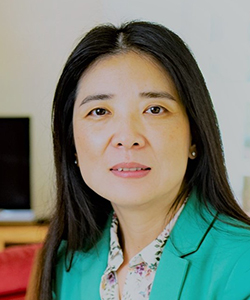
Institute for Language Sciences, Utrecht University
Aoju Chen, professor of Language Development at Utrecht University, the Netherlands, is a leading researcher in speech prosody and interdisciplinary research on prosody acquisition in a first and second language. She is the holder of several major grants for research on prosody and prosodic development. She and her lab have worked extensively on the production, perception, and processing of prosodic meaning and acquisition of prosody in a first and second language from a cross-linguistic perspective. She put forward the first cross-linguistic model of the acquisition of prosodic focus marking. Current research in her lab bridges speech prosody with language development, foetal learning, and neuroscience, and explores the interaction between innate biases in prosodic production and perception with input-driven learning mechanisms in prosodic development before birth and in the first three years of life. Aoju Chen was a visiting researcher at Edinburgh University (2002/3) and the University of Illinois at Urbana-Champaign (2016), and a visiting professor at the 2011 LSA Linguistic Institute (University of Colorado at Boulder). She served as an associate editor of Laboratory Phonology (2026-2022) and is currently an elected board member of the ISCA (International Speech Communication Association) Special Interest Group on Speech Prosody.
Room GER 242, Tuesdays and Fridays, July 25-August 8, 2:30pm - 3:50pm
Tuesdays and Fridays